1 cup chinese chives or scallions (sliced into ½ inch pieces)
¼ cup ginger (peeled and minced)
1 cup gochugaru (korean chili powder)
1 tablespoon sugar
1/4 cup sweet rice flour (optional thickening agent)
up to 3 cups reserved liquid from the brine
Categories
Side Dish
Cuisine
Korean
Steps
Prepare the brine by mixing the water and sea salt together in a very large mixing bowl until the salt dissolves. You can also split the brine into two bowls using 1 gallon of water and 1 cup of salt per bowl if your bowl isn’t big enough.
Wash the cabbage in cool water.
Remove and reserve a few of the large outermost leaves of the cabbage for later.
With the remaining cabbage, slice the cabbages into quarters and place into the brine.
Add a plate over the top of the cabbages. Then add your weights over that to keep the cabbage submerged in the brine.
Let the cabbage soak in the brine for 4-6 hours.
After soaking, reserve 3 cups of brine and set aside. (Don’t forget this step!)
Then drain the cabbage in a colander.
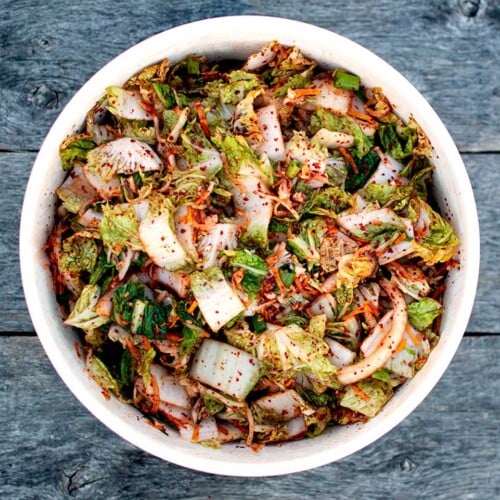
Chop cabbage into bite size pieces and place in a very large bowl.
Add radishes, carrots, garlic, onion, chinese chives, ginger, gochugaru, and sugar. Mix well.
Transfer the mixed vegetables and spices into your fermentation crock a little at a time, using the stomper to firmly push down the vegetables, Packing as tightly as possible.
Once all the mixture is in the crock and stomped down, add the reserved whole cabbage leaves over the top. This will create a cover to keep the chopped vegetables from coming out of the brine and floating to the top.
Place your weights on top.
Add only enough reserved brine to cover all the vegetables but only a little bit. Additional liquid will release from the vegetables during the first few days of the ferment. *IMPORTANT* If you add too much brine, the end result will be salty and watery, again add only enough that it covers the vegetables fully after weighing it down.
Cover the crock with a plate, lid, or towel, and let ferment in a cool, dark area for 7-28 days. You can begin taste testing at 7 days. The longer you ferment the more pickled the flavor will become.
When the ferment is finished, remove kimchi from the crock and place in individual mason jars with lids. Recipe yield is approximately 5 quarts of kimchi.
Kimchi should be stored in the refrigerator when the ferment is finished. It can also be stored in a root cellar as long as it hovers between 32 and 40ºF. Under these conditions, kimchi will stay fresh for nine months to one year.
Reviews
Jocelyn on 2024-08-13 (5 stars): I'm in the process of making this now but I have followed a similar recipe in the past and it came out delicious!