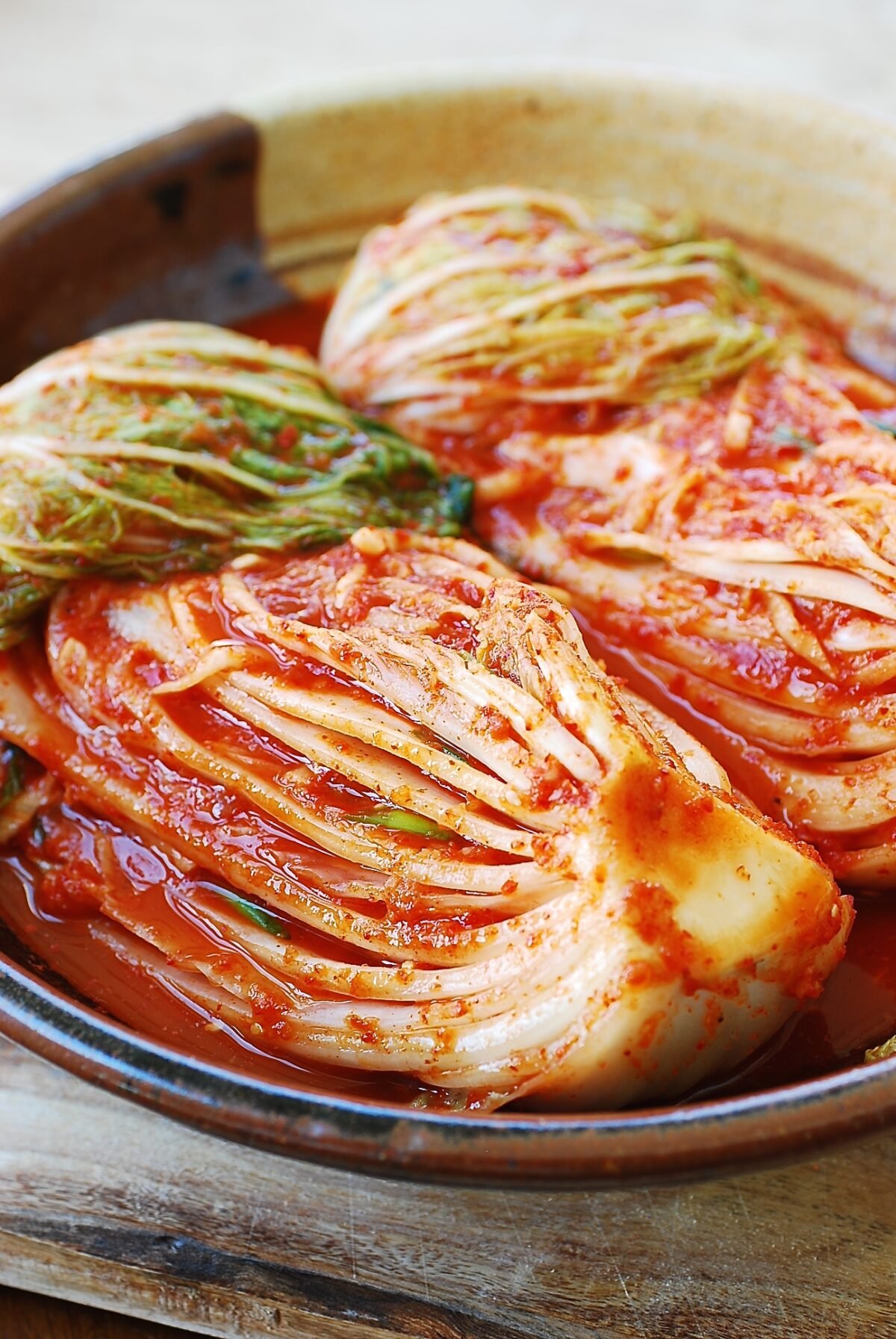
This Korean kimchi recipe shows you everything you need to know about how to make traditional cabbage kimchi. With this small batch recipe, you’ll find it not that difficult to make good authentic kimchi at home.
Recipe by Hyosun on November 4, 2019
Prep time: PT120M
Total time: PT480M
Rating
4.64 stars (321 reviews)
Keywords
fermented, kimchi, Kimchi recipe, pogi kimchi, side dish
Ingredients
1 large Napa cabbage, baechu (배추), (about 5 to 6 pounds, or 2 small (about 3 pounds each))
1 cup Korean coarse sea salt, gulgeun soguem (굵은소금)
5 cups water
1 pound Korean radish, mu (무)
1/4 large Korean pear (배) (optional)
3 - 4 scallions
1 piece dasima, 다시마 (dried kelp), about 2 to 3 inch square) - optional
1 tablespoon glutinous rice flour, chapssal garu (찹쌀가루)
1/2 cup gochugaru, 고추가루 (- adjust to taste)
1/4 cup saeujeot, 새우젓 (salted and fermented shrimp), (roughly chopped )
3 tablespoons myulchiaekjeot, 멸치액젓 (fish sauce)
3 - 4 raw shrimps, about 2 ounces, finely minced or ground (- optional)
3 tablespoons minced garlic
1 teaspoon grated ginger
1/2 cup water or dasima broth
2 large bowls or pots (7 - 8 quarts)
a large colander
kitchen gloves
3/4 - 1 gallon airtight container or jar
Categories
Side Dish
Cuisine
Korean
Steps
Cut the thick white part of the cabbage in half lengthwise. Then, slowly pull it apart to separate into two pieces. Do the same for each half to make quarters. Running the knife through all the way would unnecessarily cut off the cabbage leaves.
In a large bowl, dissolve 1/2 cup of salt in 5 cups of water. Thoroughly bathe each cabbage quarter in the salt water one at a time, shake off excess water back into the bowl, and then transfer to another bowl.
Using the other half cup of salt and starting from the outermost leaf, generously sprinkle salt over the thick white part of each leaf (similar to salting a piece of meat). Try to salt all the cabbage quarters with 1/2 cup salt, but you can use a little more if needed. Repeat with the rest of the cabbage quarters. Pour the remaining salt water from the first bowl over the cabbage. Set aside for about 6 - 8 hours, rotating the bottom ones to the top every 2 - 3 hours.
The cabbages should be ready to be washed when the white parts of the leaves are bendable. It's okay to have a bit of resistance. Rinse thoroughly 3 times, especially between the white parts. Drain well, cut side down.
Meanwhile, make the optional dasima broth by boiling a small piece (2 to 3 inch square) in 1.5 cups of water for 5 minutes, and cool. Mix the rice flour with 1/2 cup water (or optional dasima broth) and simmer over low heat, stirring occasionally, until it thickens to a thin paste, and cool. Yields about 3 - 4 tablespoons.
Prepare the garlic, ginger and saeujeot. Combine all the seasoning ingredients, including the rice paste and about 1/2 cup water (or the optional dashima broth), and mix well. Set aside until the gochugaru dissolves slightly and becomes pasty.
Cut the radish and optional pear into matchsticks (use a mandoline if desired), transferring to a large bowl. Cut the scallions diagonally into about 1-inch long pieces. Add the prepared seasoning mix to the radish, and mix well by hand. Throw in the scallions, and mix everything lightly. Taste a little bit. It should be a little too salty to eat as is. You can add salt, more salted shrimp or fish sauce, as needed. Let it sit for about 30 minutes to allow the flavors to meld nicely.
Cut off the tough stem part from each cabbage quarter, leaving enough to hold the leaves together. Place one cabbage quarter in the bowl with the radish mix. Spread the radish mix over each leaf, one to two tablespoons for large leaves. (Eyeball the stuffing into 4 parts and use one part for each cabbage quarter.)
Fold the leaf part of the cabbage over toward the stem and nicely wrap it with the outermost leaf. Place it, cut side up, in a jar or airtight container. Repeat with the remaining cabbages. If you have loose large leaves, you can use them to cover the top of the kimchi (see note 1). Once all the cabbages are in the jar or airtight container, press down hard to remove air pockets. To collect any remaining seasoning, rinse the bowl with 1/2 cup of water (or the remaining optional dasima broth), and add it to the kimchi container. Close the lid.
Leave it out at room temperature for a full day or two. It can be longer, depending on the weather and how fast you want your kimchi to ripen. Then, store in the fridge. (see note 2)
Reviews
Kristine on 2026-02-08 (5 stars): Very good. Everyone I share it with, loves it. Even a couple that have lived in South Korea for several years love it. They said it is better than store bought.
Thank you for sharing your recipe 😊
Collet on 2025-11-04 (5 stars): Hyosun, I actually posted pictures of me making your kimchi on a group page for my area of WV a few weeks ago. I'm going to be teaching about 5 people tomorrow how to make kimchi, with your recipe! Credit to you will be given often and loudly. Thank you so much.
Veronica Sprague on 2025-02-13 (5 stars): I really appreciated the video tutorial of this recipe. I've made it several times and I don't always have all of the ingredients or the exact measurements but it always turns out great! It's best after a few months in the fridge in my opinion ;)
Collet Crabill on 2025-02-10 (5 stars): Thank you for this fabulous recipe! I've made it a couple of times, but I was wondering if I can add a new batch to the small amount I have left in the fridge. I'm thinking of pulling out the older amount and putting it on top of the new batch, I don't have enough space for two large containers.
Steve Webb on 2024-03-03 (5 stars): Today l am making the second batch….. I have just eaten the last bit from the first time l tried your wonderful recipe… it is soooo good! I was a bit lazy and did not grate the ginger and my vegetables were not chopped fine enough… but … after a few weeks it tasted amazing. Now l have taken much more care over the whole process….watched your video many times .. you are a great teacher. My wife is laughing at me..calls me the 'Cabbage Boy' ! I don’t mind.. one question… Korean Radish…so hard to find. Is there anything that might be a suitable substitute?
All the best to you and thanks so much for a great new taste experience .
Cece on 2024-02-11 (5 stars): Hello! I accidentally missed the step to pour the brine water back over the cabbage after dipping. So it soaked for 8 hours with only the half cup of salt I sprinkled on the leaves. Will it be ok? Thank you!
Steve Webb on 2024-02-07 (5 stars): Fantastic recipe… thanks so much!! Very clear instructions.
My Daughter discovered Kimchi when she lived in Japan.
I have always had stomach trouble … old rock and roll guy… too ,inch junk food! I started eating store bought kimchi 6 months ago… it really helps to get a healthy gut… then l looked for recipes as the stores over here in Finland do not have it on the shelves all the time… not a well known food. Today l make my first batch with your recipe… it is so good at the tasting stage. You are my new go to teacher!! Bless you and your loved ones.
Alex on 2023-12-14 (4 stars): I’m looking for a more traditional kimchi recipe like my papa used to make. I remember him burying jars in the yard and storing them in a dark back unused room for long periods of time when we were kids to remember ferment properly.
Today’s kimchi tastes like it’s got sodium bicarbonate in it which is off to me. It isn’t right.
Anyone able to get into the real processes of the kimchi fermenting making of it all? I want the real deal just like grandpa made. It was the best!