
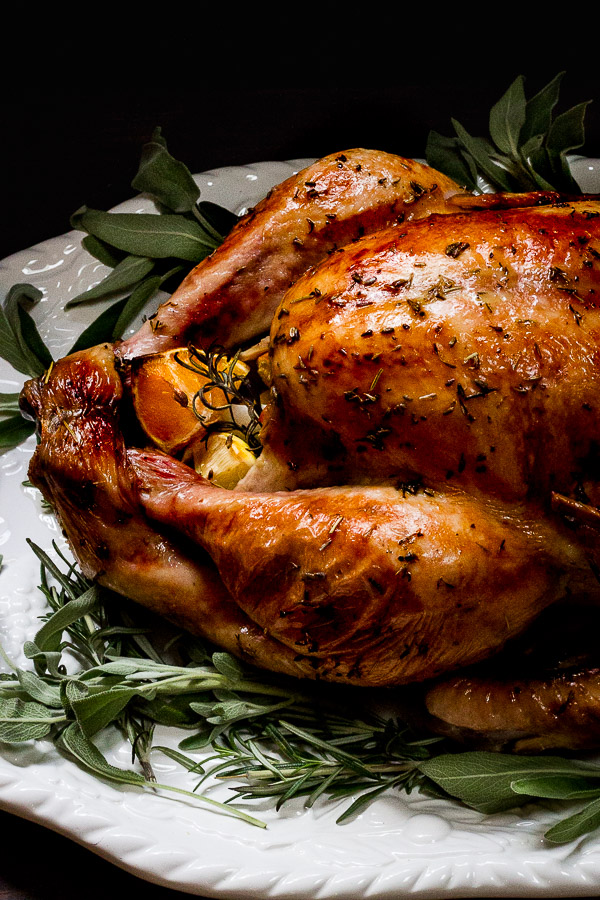


Butter-roasted and filled with aromatics for a succulent turkey with a white wine pan gravy
5 stars (3 reviews)
holiday, turkey
- Mix the Herbes de Provence into the softened butter and set aside.
- Clean the turkey by draining any excess moisture from inside the cavity and removing the giblets (they're usually found in a bag inside the cavity). Reserve the neck, and pat the turkey dry with paper towels.
- Line a roasting pan with all of the pan ingredients except for the chicken broth.
- Place the turkey on top of the pan ingredients (these ingredients will hold the turkey up instead of using a roasting rack). To the inside of the turkey loosely pack with the orange and lemon wedges, the head of garlic, and the onion wedges, alternating the pieces as you go. Lastly, add the sprigs of fresh herbs.
- Secure the legs with twine or tuck them under the fold of skin.
- Generously rub the herbed butter all over turkey and between the breast meat and skin, careful not to rip the skin. (Tent with heavy-duty foil and refrigerate overnight.
- Allow the turkey to sit at room temperature at least 30 minutes before roasting. When ready to roast, add only 3 cups of the chicken broth to the pan and roast for 45 minutes, loosely tented in foil.
- Reduce the oven temperature to 325 F. Remove and discard the foil. Pour the remaining cup of broth into the roasting pan. Only re-cover the turkey breast if it begins to roast too much, occasionally check it throughout the cooking time.
- Cook the turkey until the internal temperature reaches 165 degrees F. (74 C.) use a meat thermometer inserted into the thickest part of the turkey thigh, careful not to touch a bone though. If you want to baste the turkey, do so only once or twice with the pan juices though it isn't necessary to baste at all (see recipe notes #1 and #2 below).
- Transfer the turkey to a platter and tent it with foil. Keep the roasting pan and juices as we’ll use it to make the white wine pan gravy, discard any solids from the pan. Allow the turkey to rest for 30 minutes before carving (Need to keep it hot a little longer? See recipe notes #3 and #4 below).
- Strain the pan juices into a fat separator with a sieve-lined lid or into a 4 cup glass measuring cup, skimming off the fat from the top. Discard any bits and solids. The pan drippings should render 4 cups of broth. If not, add chicken broth to the measuring cup, so that you have a total of 4 cups of liquid to make the gravy.
- Add the wine to the roasting pan. Over two burners on low-medium heat, deglaze the pan by scraping up, and stirring in, any flavorful browned bits that have stuck to the bottom of the pan. Allow the wine to reduce a bit, about 3-4 minutes.
- Melt the butter into the roasting pan.
- Add the reserved 4 cups of pan drippings to the roasting pan and bring to a low boil. Slowly add the cornstarch slurry (see recipe note #5 below) while continuously whisking to blend. Keep whisking until the gravy reaches the desired consistency which should be silky and thick, but not so thick that it isn’t pourable, about 10 minutes or the time it takes – if the gravy isn’t thickening-up, raise the temperature while continuously whisking or make more slurry, starting with with 1 tablespoon of cornstarch and 1 tablespoon of cold broth, mixing well to combine.
- Season with salt and pepper. Taste and adjust the seasonings. Strain the gravy and pour into a gravy boat if ready to serve or keep warm until ready to use (see recipe notes #6 – 8 below). Gravy will thicken as it cools.