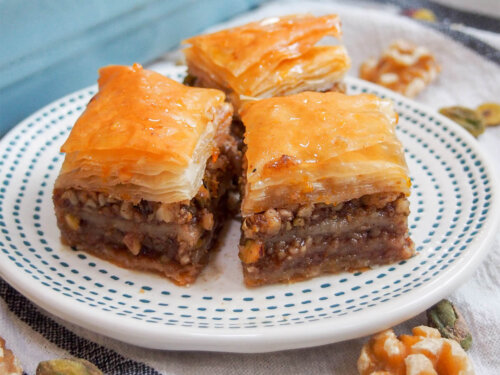
Baklava is a classic treat of crisp pastry layered with nuts, drenched in a delicious honey syrup. Addictively good!
Prep time: PT30M
Cook time: PT45M
Total time: PT75M
Rating
4.84 stars (6 reviews)
Keywords
baklava, filo pastry
Ingredients
8 oz filo pastry ((8oz is about 10 sheets))
6 oz walnuts
2 oz pistachios
2 tbsp sugar ((white or brown is OK, but a finer grain is better))
1 tsp cinnamon
1 tsp ground cloves
4 oz butter
1/2 cup water
1/2 cup sugar
1/4 cup honey ((1/4cup is 4tbsp))
1 tbsp lemon juice
1/2 orange zest ((ie from 1/2 orange, removed after))
3 cloves ((whole, removed after))
Categories
Snack
Cuisine
Greek
Turkish
Steps
If the pastry is frozen, defrost it overnight in the fridge, in the original packaging.
First prepare the filling by finely chopping the walnuts and pistachios, then mixing both together with the sugar, cinnamon and cloves. While it takes a bit of time, you are best to chop the nuts by hand as the pistachios in particular don't really cut properly in a food processor. You also don't want them as fine as breadcrumbs, just small pieces. Divide the nut filling into 3 small dishes for ease later.
Have a pastry brush and baking dish ready - I used a 10.5x7in (26x18cm) dish, about 1 1/2in/7cm deep in the inside. Cut one piece of filo pastry into quarters (giving you 4 pieces with the long edge the same as the original) and test a piece in the dish. If it is a little short, as mine was, have some foil ready to fill the gap later and build slightly to one side. If the pastry is too big then see if you have another dish that better fits or be ready to trim the pastry as you go (but be aware it takes a little longer).
If you prefer, you can get all the pastry ready by cutting 10 sheets into quarters, but be aware you need to keep them covered until needed or they will become dry and brittle. Alternatively, keep the pastry in the original wrapping and cut a sheet as needed. If you need to trim the pastry, then you can use trimmings to make a layer now and then, just not the first layer after adding nuts nor on the to.
Melt the butter (either in the microwave in 30 second intervals, or on the stove in a small pan). Be aware you may need to melt it again as you go, since it is likely to harden while you are building the baklava.
Lightly brush the baking dish with butter then place one piece of the filo pastry in the bottom in a single layer. Working quickly, and keeping any pastry you are not using either in the original wrapping or under a damp cloth, brush the pastry in the dish lightly with butter then add another layer on top. Repeat until you have 10 layers of pastry in the dish.
Next, add one of the dishes with the nut filling (ie 1/3 of the total) and spread over the pastry.
Add another layer of pastry, brush with butter, then repeat adding additional layers. The first layer after the nut filling is always a little tricky to brush so make sure it is one that is not brittle and hold it slightly on one edge as you brush. Once again, add 10 layers.
Around this point, preheat the oven to 350F/175C.
After the 2nd 10 layers of pastry, add another layer of nuts, then another 10 layers of pastry, layer of nuts, and a final layer of pastry. In total, you will have 4 sets of 10 sheets of pastry, with 3 layers of nut filling in between.
Once you have finished building the baklava, brush the top with butter. If you have a gap at the edge of your dish, fill this with crunched up foil. Score the baklava before cooking, cutting at least the top layer of pastry, but in to lower levels is fine too (and I find it better). Traditionally, this is in diamond shapes, but you can also cut small squares/rectangles.
Bake uncovered for approximately 45 minutes, or up to 60 minutes, until it is golden on top.
While the baklava is baking, prepare the syrup. Place the water, sugar, honey, orange zest and cloves in a small pan and warm gently over a medium-low heat. Stir so that everything dissolves and mixes. Once it comes to a boil, simmer for a couple minutes then set aside. Remove the orange zest and cloves and stir in the lemon juice before using.
Once the baklava is golden on top and the layers of pastry appear cooked, remove from oven and pour over the syrup while it is still hot. Do this carefully as it may sputter, and try to spread the syrup evenly over the baklava. Leave it to cool completely before cutting. Cut on the markings you made previously all the way down and removing stacks of pastry and nuts.
Nutitrion
Serving Size: 1 serving
Calories: 204 kcal
Carbohydrates: 20 g
Protein: 3 g
Fat: 13 g
Saturated Fat: 4 g
Cholesterol: 14 mg
Sodium: 107 mg
Sugar: 11 g
Reviews
Marie Peters on 2024-10-17 (5 stars): I’m new to making baklava. I tried this recipe, and it was both easy and delicious. I intend to make it again, but a full size pan of it. Other than doubling everything, do you have any tips?
Malaak on 2020-12-14 (5 stars): I love baklava it's soo tasty i cant even resist it's smell, it's look and the taste i love it so much thank you Caroline!
Janet McKaren on 2020-04-24 (5 stars): I have tried lots of baklavas and this is my favourite recipe. I usually make it during springtime just like this year. My family are going crazy over this recipe and want me to make it again.
Thanks for the recipe,
Janet
Bob on 2019-12-31 (4 stars): Some nice ideas there. Despite all the “mythology” about syrup temperature vs baklava temperature, as long as the baklava is well cooked all the way through, pouring hot syrup on hot baklava will work the best.
Also the note about using ripped phyllo is spot-on. When cooks in Turkey roll their own phyllo (it really is worth it!) they cut the perfect top sheets first, all together, and roll them around another pin separately to lay over the top at the end. The main body of the baklava is composed of all the edges of the sheets.
Here are a couple hints to make this easier; though the last one is an extra step it will make things look nicer.
Instead of brushing on the butter, only brush the pan. The rear can be sprinkled with a brush. As you build it, sprinkle in between ever 5-6 layers. You’ll see why in a second. This way there’s no danger of marring sheets. It’s best to sprinkle between the very top sheets but you don’t really have to; you can just lay them on.
After the baklava is assembled, make all the cuts in one direction, then pour the melted butter over the top and along the cuts. (The butter will get everywhere it needs to be.) Let the butter cool and set up a little, THEN make the cross-cuts. This will hold everything together and keep the sheets from slipping around.
And last - use clarified butter. This will eliminate any spotting because of bits of milk solids.
And a last note - don’t brown it too much. Baklava always looks darker after they syrup goes on; err on the side of slightly light but well cooked all the way through!
Calleigh on 2019-12-02 (5 stars): This recipe is simpler that I thought.. I love the perfectly flaky phyllo dough with my favorite nut mixtures like walnuts and pistachios, then finished with homemade honey syrup. Delicious!!
Beth on 2019-12-02 (5 stars): That is so fun that you were able to travel and bring back tasty recipes like this one. I love that this is a smaller batch just for me!