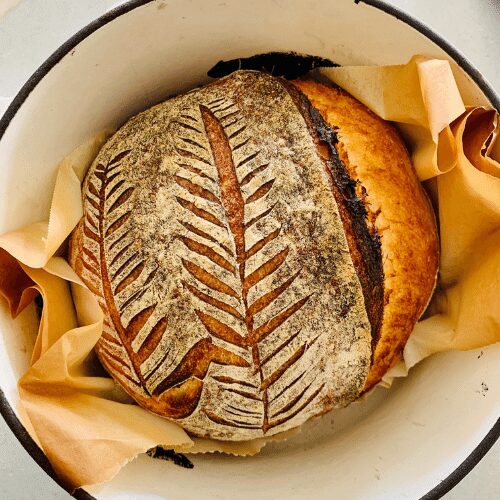
This easy sourdough bread recipe is beginner-friendly and foolproof. With simple steps and plenty of hands-off time, you’ll bake a crusty, golden loaf with a soft, airy crumb. Perfect for everyday baking.
Prep time: PT360M
Cook time: PT45M
Total time: PT1845M
Rating
4.5 stars (245 reviews)
Keywords
Sourdough Bread, Sourdough Recipes
Ingredients
500 g Bread Flour
350 g Water
50 g Sourdough Starter
10 g Salt
Categories
Bread
Cuisine
American
Steps
Fermentolyse - Premixing The DoughWeigh out your sourdough starter and water into a large ceramic or glass bowl. Mix the water and starter together briefly. Then add your flour and salt and mix whole lot together to form a shaggy dough. You can use a dough scraper or long jar spatula to do this. I don't like using hands at this stage as it's way too messy!The dough will be fairly shaggy and only just brought together. You might wonder how this will turn into bread, but just wait, time is your friend and the dough will change in around an hour.
Cover your bowl with a plastic bowl cover or damp dish towel and let it sit for around 1 hour.
Forming Up The DoughAfter the dough has been through fermentolyse you need to bring it together into a ball. Work your way around the bowl, grabbing the dough from the outside, stretching it up and over itself, into the centre, until a smooth ball is formed (I usually do around 20 folds here). You're taking the dough from a rough shaggy dough into a smoother, more elastic dough.
Once the dough has formed into a smoothish ball, pop the plastic bowl cover back on and allow it to rest for around 30 minutes.
Stretch & Fold - Creating StructureOver the next few hours you need to create even more structure for your dough by "stretching and folding". Aim to do around 4-6 sets of stretches and folds. For each set, stretch the dough up and over itself 4 times. Leave around 15 minutes in between each set. Again you do not have to be exact with time, but you need to do at least 4 sets over 2 hours.
Bulk FermentOnce you've finished your stretch and folds, place the plastic bowl cover or damp tea towel back over your dough and let it rest and ferment (a plastic cover is a better option for this stage).See notes below for more info on this step.
Shaping The DoughOnce your dough has finished it's first ferment, it's time to shape it into either a boule or a batard. I don't like using flour for shaping, however if you feel you need it, give your counter a really light dusting of rice flour or semolina flour.Use a silicone dough scraper to gently ease the dough out of the bowl. You want it to land upside down on your counter so that the smooth top of the dough is on the countertop and the sticky underside is facing up. This will make it easier to shape and allow you to use the dough to create it's own surface tension.I like to make batards, but you can also create a boule. You can see a video of me shaping the dough at the top of this recipe card.
Placing Into A BannetonOnce the dough is shaped into a boule or batard with plenty of surface tension, place it into your banneton smooth side down, so your seam is on the top. Stitch the top of the dough together if you need to.Lift your dough around the edges to pop a little more flour if you feel it needs it. Just try to handle the dough as little as possible and be really gentle as you really want to preserve all the gases and air bubbles that have formed during your bulk ferment.
Cold FermentNow the dough is in its proofing basket, cover it loosely with a plastic bowl cover or damp dish towel and place into the refrigerator.Try to leave it in the fridge for a minimum 5 hours up to a maximum of around 36 hours. The longer you leave it the better your bread will be! A longer cold ferment creates beautiful blisters on your crust and a deeper sourdough flavour.
Preparing To BakeOnce you're ready to bake your sourdough, you'll need to preheat your oven to 230ºC/450ºF. Place your Dutch Oven into the oven when you turn it on so it gets HOT. Try to preheat for around 1 hour to ensure your oven is super hot - but you know your oven so just adjust this time if you need to.Leave your dough in the fridge until the very last minute - placing a cold dough into a hot oven will give you a great oven spring.
Let's Bake Your Sourdough BreadWhen your oven is at temperature, take your sourdough out of the fridge. Gently place it onto a piece of parchment paper.Make sure that you make the baking paper big enough to use the edges as a handle to lower to dough into your Dutch Oven.Gently score your bread with a bread lame or clean razor blade. At minimum a large cross is sufficient, but you can get as artistic as you like. Check out this guide to scoring sourdough bread.Carefully take your Dutch oven out of the oven. Place the sourdough into the pot using the parchment paper as a handle. Put the lid on and place into the hot oven. BAKE TIME:30 Minutes with the lid on at 230ºC/450ºF plus10-15 Minutes with the lid off at 210ºC/410ºF
Finishing The BakeWhen you remove your dough from the oven, carefully remove it from the dutch oven as soon as possible and place on a wire rack to cool.
Nutitrion
Serving Size: 100 g
Calories: 1851 kcal
Carbohydrates: 372 g
Protein: 61 g
Fat: 8 g
Saturated Fat: 1 g
Sodium: 3904 mg
Sugar: 2 g
Unsaturated Fat: 5 g
Reviews
Antonina on 2026-04-30 (5 stars): A couple of months ago I decided to try to get a sourdough starter going after a few years hiatus. I hadn’t decided on a sourdough recipe yet. But then I remembered your wonderful informative and easy to follow recipes and website. I am so glad I found you. My first 3 loaf bake was amazing even with their flaws.. Thank you, thank you, thank you
Emily D on 2026-04-20 (5 stars): Could I bake these in loaf pans? im going to be using my PitBoss to make it and I didnt like putting my dutch oven in it last time.
Sandy on 2026-04-19 (5 stars): my softest bread yet! wonderful for scoring as well. worked beautifully!
Keri on 2026-04-06 (5 stars): Im now a few months in on my sourdough journey. Ive always liked to cook but kind of a lazy one pot person whenever possible and have never ever been a baker and saw a post about starter and just thought id give it a shot and have been obsessed since! your recipes are all amazing and work wonderfully. ive made this recipe a dozen times and its so good every single time. Thank you so much for being there and I love all your recommended products!
Maryann on 2026-04-03 (5 stars): Hello Pantry Mama, I just had to come back here to tell you my experience. Making sourdough bread has been on my bucket list for years. I must have tried 4 different methods and recipes and I failed. I cake across your website which by the way has a wealth of info and recipes. I tried your overnight sourdough bread recipe and Im giddy!!! It's the most beautifle loaf I have ever made. I'm looking forward to your other recipes to try. I can't stop looking at the bread.....
Anna on 2026-03-29 (5 stars): Love this recipe! It's my jumping off point for all the inclusions. Turns out great every time!
Maria Bertone on 2026-03-08 (5 stars): I am new to sourdough baking but not baking itself. I came across you during a Google search and will now only stick to you - also following you on Instagram. Was extra delighted to realise you are a fellow compatriot (I'm from Western Australia but live in the UK). Sourdough baking is a minefield and it was a relief to find someone who keeps it simple and whose website and recipes are a joy. I am still experimenting but may I please ask a question? Once having shaped the dough and placed on a floured cloth for cold fermentation (my preferred method that brings me greater flexibility), is there any reason why I could not place on a baking paper, then into the bowl in fridge? This would alleviate having to transfer from cloth to baking paper then my Dutch oven and instead, lift and place straight into hot Dutch oven. I would be very interested to have your thoughts on this. Keep up the great work and inspiration.
Cristal on 2026-03-07 (5 stars): I tried and tried to make sourdough with several different recipes, but without success. I found pantry mama’s recipe and it has proven to be the best that I have ever found. I would like to get more comfortable with doing like a garlic and cheese, bread or herbs and cheese bread but I’m not there yet.
Taylor on 2026-03-01 (5 stars): This recipe has given me amazing sourdough which I’m only surprised by because I’m a sourdough newbie! A labor of love but all my loaves have turned out so yummy.
Julie on 2026-01-21 (5 stars): Hi- I saw your video on making mini loaves in a muffin tin but can't find that anywhere? I'm guessing the recipe is the same until shaping? Could I get info on that?! Thanks!