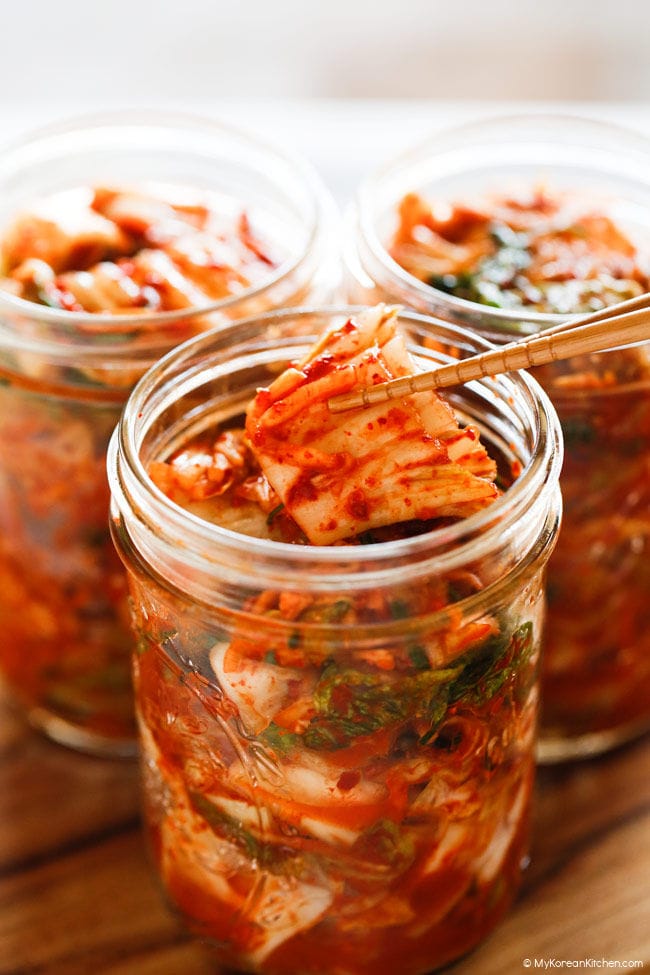
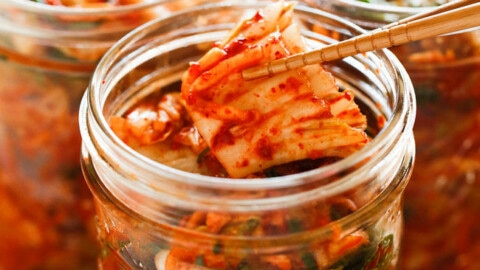
Learn how to make napa cabbage kimchi, a popular Korean side dish made from fermented napa cabbage, radish, and Korean chives. Includes step-by-step kimchi making instructions, and handy tips for making the best kimchi.
Recipe by Sue Pressey on January 24, 2022
Prep time: PT150M
Total time: PT510M
Rating
4.79 stars (37 reviews)
Keywords
baechu kimchi, kimchi, napa cabbage kimchi, pogi kimchi, traditional kimchi
1.5 cups Korean coarse sea salt (or natural rock salt (for salt water), (285g / 10 ounces))
1/2 cup cooking salt (, medium sized crystals (for sprinkle), (97g / 3.4 ounces))
2 Tbsp glutinous rice flour ((sweet rice flour))
1.5 cups water ((360 ml))
1.5 cups gochugaru ((Korean chili flakes), (141g / 4.97 ounces))
540 g Korean radish (or daikon radish (19 ounces), julienned)
1 Tbsp fine sea salt
3.5 Tbsp Korean fish sauce
2 Tbsp salted fermented shrimp (, minced)
90 g Korean chives ((3.2 ounces), cut in 5 cm / 2 inch length)
140 g carrots ((4.9 ounces), julienned)
1/4 cup minced garlic ((42g / 1.48 ounces))
1/2 Tbsp minced ginger
2 Tbsp raw sugar
75 g onion ((2.6 ounces), blended (with a stick blender or vegetable chopper) or finely grated)
Categories
Side dishes
Cuisine
Korean
Steps
Cut the napa cabbage into quarters and rinse it in running water. Make sure the stem is intact.
Dissolve the coarse salt in the water (16 cups) in a large bowl. Dip the napa cabbage in the saltwater one at a time and transfer it onto a tray for further salting.Pinch some cooking salt (1/2 cup total for all pickled cabbages) and rub over the thick white part of the cabbage. Open each leaf gently and sprinkle the salt over the thick white part. Repeat this for the rest of the cabbage. Reserve the saltwater from when you soaked the cabbage for later use.
Put the salted cabbage in a large food grade plastic bag or large bucket (wedge side of the cabbage to be facing up) and pour in the reserved saltwater from step 2. Close the plastic bag. If using a bucket, get something heavy on top of the cabbage to press down (e.g heavy pot with water).Set the cabbage aside for 6 hours to pickle. Rotate the cabbage upside down every 2 hours. Using a large food grade plastic bag will make the turning process much easier than using a large bucket.
Once the soaking process is finished, rinse the cabbages in running water, especially the thick white part of the cabbage, to get rid of the salt. Place them in a colander and allow to drain for 1 hour.
While waiting, prepare the glutinous rice paste. Mix glutinous rice flour with the water (1.5 cup) in a saucepan and boil it over medium heat for 5-8 minutes, until it thickens. Once ready, transfer the rice paste to the medium-size bowl and let it cool. Add Korean chili flakes once it has cooled. Then, combine them well.
Prepare a large mixing bowl and add radish, fine sea salt, Korean fish sauce, and salted shrimp. Leave it for 10 minutes for the radish to salt down. Add Korean chives, carrots, minced garlic, minced ginger, sugar, blended onion, and the Korean chili flakes mixture from step 5. Mix them well. Now the kimchi seasoning / kimchi paste is made, ready for use.
Place a quarter of a cabbage on a tray. Spread the seasonings over each leaf. (You only need to season one side of the leaf.) 1 to 2 small fistfuls of seasoning is enough per quarter of cabbage. Repeat this step for the rest of the cabbage. Don’t pull the cabbage leaves off the stem, leave them attached so it holds together better.
Transfer the kimchi into a kimchi container or an airtight container (and put the lid on). Leave it out at room temperature for 24 hours, then move it to the refrigerator. While you can start eating it once it’s chilled, you may want to wait 3-4 more days for it to develop more flavor.
Once the kimchi is ready to eat, chop a small portion and store it in a smaller glass container. This makes it more convenient to serve with your meal. Keep the other batches intact in the large kimchi container. This way, you only cut it up as needed, which helps keep the remaining kimchi fresh longer.
Nutitrion
Serving Size: 1 serving
Calories: 196 kcal
Carbohydrates: 37 g
Protein: 9 g
Fat: 7 g
Saturated Fat: 1 g
Sodium: 33425 mg
Sugar: 11 g
Unsaturated Fat: 6 g
Reviews
Ram on 2026-03-13 (5 stars): I really like this recipe and I already made it three times. It has the perfect amount of salt, which was always the problem with most previous recipes I tried (usually too salty). I just skip the shrimps and add a little more fish sauce to compensate. Also, even though I soak and wash the cabbage quarters intact, I cut them apart right before mixing it with the paste. I cut the stem off, and divide the bigger leaves along and across (into four larger pieces). I personally prefer it that way. I also had to adjust the amount of chili flakes. Because even though my chilli places between mild and medium, I needed to decrease the amount to three fifths of the original amount. (I am using Nongshim Taekyung TK Chili Powder, 3-5/10 intensity.)
Tanya Lafferty on 2026-01-12 (5 stars): This is delicious! Nice bite from the gochugaru! Everything blended well, the recipe was very easy to follow! And the taste, omg, I can’t say it enough, homemade is best!
TJ J on 2026-01-10 (5 stars): Oh my tried this kimchi recipe for my first time ever and it turned out soooo good. Wow. So much better than the stuff you get from the store.
derkatchi on 2025-12-15 (5 stars): I have another question and this time about Korean radish. Is there a preferred size to use for it? I picture it varying like daikon from small to huge. I wonder if the size affects the taste. Also, about the brining of the radish, forgive me for asking. Are we supposed to dump the brine/water and rinse the radish after doing so? TYIA
Derkatchi on 2025-12-13 (5 stars): Thank you so much!!! We’ve used your recipe three times now with slight variations and all of them have turned out quite well. Adding fermented shrimp (우리바다 새우젓, to be exact) in the last batch made a noticeable difference.
I am using Squid (brand) fish sauce since it’s anchovy-based, I haven’t come across a Korean variety yet. I also haven't found Korean chives but we are on the lookout. We shop mainly at 99 Ranch and Hồng Phát in Portland, Oregon.
Derkatchi on 2025-11-18 (5 stars): I came to this refuge after asking chatGPT who offered a recipe with no rice flour or carrots. I'm currently fermenting mine at 64°F on a heating mat in a somewhat cold house. I'm wondering what you might think is the ideal fermentation temperature. chatGPT said:
-------
For the best overall flavor and texture, ferment kimchi at 65–72°F (18–22°C). This range produces steady bubbles, balanced acidity, and keeps the cabbage crisp without sharp sourness.
60–65°F (15–18°C): Very slow, clean-tasting fermentation. Produces mild sourness and excellent crunch but takes several days longer.
65–72°F (18–22°C): Ideal range. Gives classic kimchi flavor—moderate tang, good effervescence, and firm texture—in 1–2 days.
72–78°F (22–26°C): Faster, more intense fermentation. Kimchi becomes sharper, more pungent, and softer. Good if you plan to cook it.
80°F+ (27°C+): Not recommended. Ferments too rapidly, turning mushy with harsher, unbalanced acidity.
Jimchi on 2025-11-10 (4 stars): Thanks for your recipe, clear instructions ans photos. Can't wait to try it in a few days. Not easy to find all the ingredients in this part of France but local black radish (radis noir) is a great substitute for daikon. Just one idea to make the instructions; putting the quantities in the body would be easier than scrolling to the top at each stage!