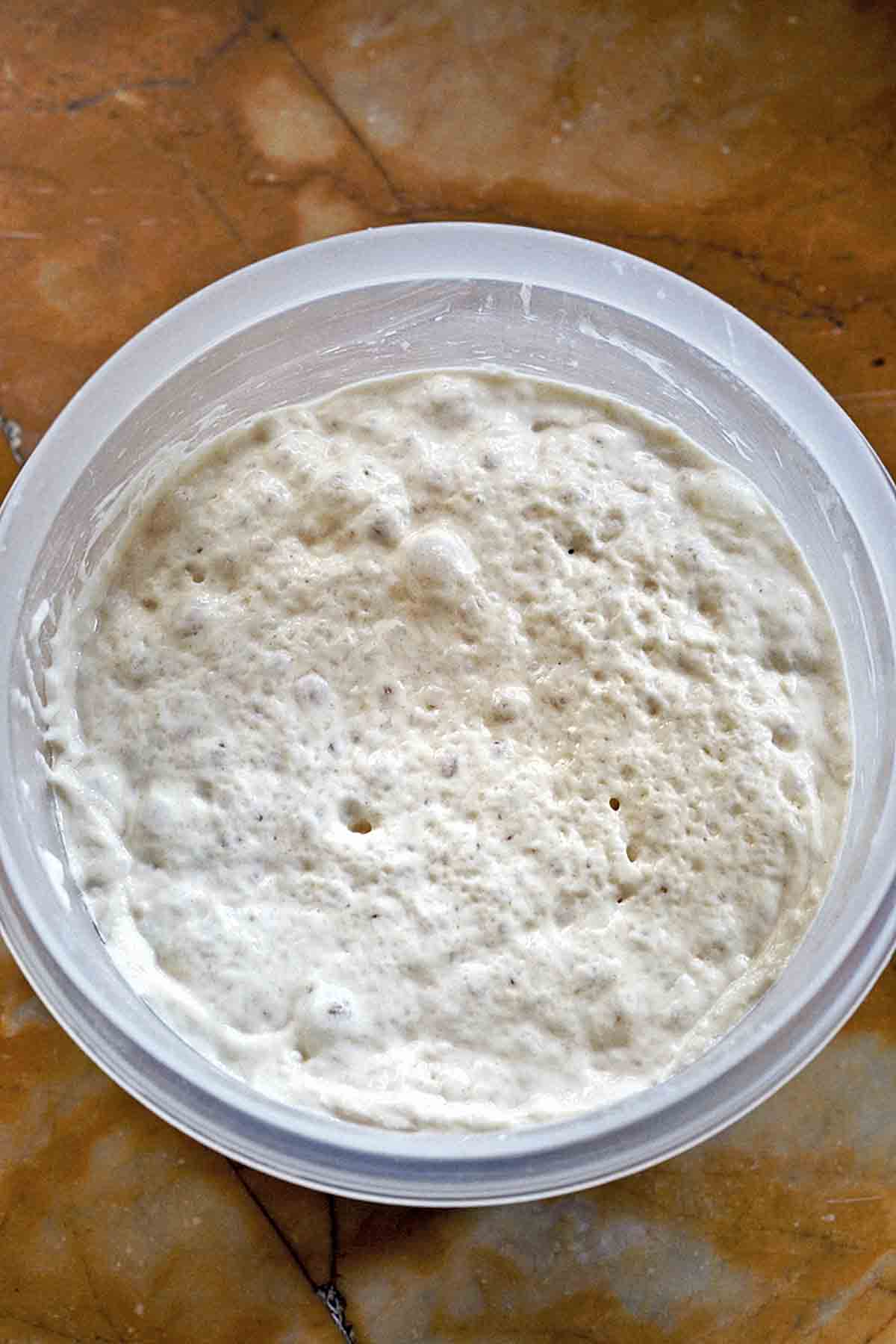
An Italian biga is a beautiful thing. It's the basis for so many traditional breads that you'll have no problem using it. The flavor is unbeatable.
Prep time: PT20M
Cook time: PT360M
Total time: PT380M
Rating
4.84 stars (36 reviews)
Keywords
baking, basic, breads, make ahead, vegetarian
Ingredients
1/4 teaspoon active dry yeast
1/4 cup warm water (100°F to 110°F (38°C to 43°C))
3/4 cup plus 4 teaspoons bottled spring water (at room temperature (You can use tap water in a pinch.))
2 1/3 cups unbleached all-purpose flour
vegetable oil (for the bowl)
Categories
Sides
Cuisine
Italian
Steps
Stir the 1/4 teaspoon active dry yeast into the 1/4 cup warm water and let stand until creamy, about 10 minutes.
Stir the 3/4 cup plus 4 teaspoons bottled spring water into the creamy yeast mixture, and then stir in the 2 1/3 cups unbleached all-purpose flour, 1 cup at a time. ☞ If mixing by hand, stir with a wooden spoon for 3 to 4 minutes. ☞ If mixing with a stand mixer, beat with the paddle at the lowest speed for 2 minutes. If mixing with a food processor, mix just until a sticky dough forms.
Transfer the biga to a bowl lightly coated with vegetable oil, cover with plastic wrap, and let rise at cool room temperature (65° to 68°F/18° to 20°C) for 6 to 24 hours, until the starter is triple its original volume but is still wet and sticky. (The bakers I admire most advise 10 to 11 hours for the first rise, but others are very happy with the 24 hours it takes for dough to truly become yesterday’s dough, and if you like sour bread, allow your biga to rest for 24 to 48 hours or even 72 hours.)
Cover and refrigerate or freeze the biga until ready to use. (If refrigerating the biga, use within 5 days. If freezing the biga, let it rest at room temperature for about 3 hours until it is bubbly and active again.) When needed, scoop out the desired amount of biga for your recipe and proceed. I strongly recommend weighing the biga rather than measuring it by volume since it expands at room temperature. If measuring by volume, measure chilled biga; if measuring by weight, the biga may be chilled or at room temperature.
Nutitrion
Serving Size: 1 cup
Calories: 536 kcal
Carbohydrates: 112 g
Protein: 16 g
Fat: 2 g
Saturated Fat: 1 g
Sodium: 10 mg
Sugar: 1 g
Unsaturated Fat: 2 g
Reviews
Russ on 2020-05-31 (5 stars): I made biga for the first time ever ( stated it Thursday night). I used this recipe and finally on Saturday morning made my first ever ciabatta. What can I say?????
Absolutely brilliant!!! 10 times better than I expected them to come out and to be honest they were near on perfect (considering I don't have baking stones or parchment paper, had to make do with tin foil and a metal baking tray ?)
I am now making another biga to use for pizza dough. When you read the recipe it does seem very long and time-consuming but in reality, you probably only spend about 10 minutes in total actually doing something (in my case it was constantly referring back to weights and in which order to do stuff ?) Make the biga well ahead of time so you don't feel like you are 'waiting' all day or night.
Thanks for this biga recipe and idea, I'm actually buzzing ????
Adrienne on 2020-04-20 (5 stars): I tried making sourdough last year, and failed miserably. I was hesitant to try this, but am SO glad that I did. My husband and I LOVED this Ciabatta bread. I let my biga rest for 24 hours before starting the bread and the flavor was amazing. I will make this again! Thanks for the detailed instructions for both the biga and the bread.
Robin Follette on 2017-10-10 (5 stars): I keep a biga going in the cool corner of our old farmhouse kitchen. Baking almost daily, I use a lot so it's handy to have it at the ready all the time. It's somehow also comforting to see it there, knowing it's ready to make wonderful bread.
Anne Wheeler on 2013-11-08 (5 stars): This is the first time my ciabatta didn't go directly to the trash! I learned SO much. My husband ate a whole loaf with butter. Good grief! I need to work...I am a potter....but making bread and cooking is so much fun! Thanks for this wonderful blog! I didn't get a picture of the finished product.....it was gobbled up! Next time!
Karen Nardella on 2026-01-13 (5 stars): Thank you.
Karen on 2026-01-12 (5 stars): David thank you for commenting. I dug deeper and I found it and I apologize for bothering you as it was from another web page. Thank you for your thoughtfulness to respond. I can share it if you want it.
Karen on 2026-01-12 (5 stars): Thank you for time and explanation David. I believe I read here a comparison of Biga, Poolish and Old Dough and how each is used. I looked everywhere and cannot find it anywhere. Was I mistaken and you did not have such an article? It was so informative. If it was you on here might you share the link for me. Thank you in advance.
Karen on 2026-01-11 (5 stars): Thank You
Harriet on 2026-01-09 (5 stars): This sounds so tasty! I have on hand AP bleached flour and bread flour. Smaller kitchen than when raising children so no room for yet another flour (the unbleached called for). Thus, which of my two flours would make a better ciabatta? Thank you!
Kay Migsi on 2025-10-08 (5 stars): That was so helpful David. Great question and one I have had as well Luci.
Kay Migsi on 2025-10-08 (5 stars): Thank you, David, for your explanations on the poolish and the biga. May I ask if both might develop their flavors well if set in the fridge to ferment rather than in a room temp situation?
If so, what might I need to change and would I use them straight from fridge then or bring to room temp first before adding them to the dough? I was thinking this as it would slow fermentation, develop deeper flavors and be more flexible for my baking schedule which in not even a couple times a week.
I hope these questions do not seem ridiculous or utterly naive, and I want to thank you for your response in advance. I'd appreciate your input, insight and thought about this possible option on the subject of poolish and biga.