Cooking duck breasts is easy once you get the hang of it. This recipe works with any duck or goose breast, wild or store-bought.
Recipe by Hank Shaw on December 15, 2014
Prep time: PT20M
Cook time: PT15M
Total time: PT35M
Rating
4.98 stars (145 reviews)
Keywords
duck, easy
Ingredients
4 duck breasts ((breasts from two ducks))
Salt
1 teaspoon duck fat or olive oil
Categories
Main Course
Cuisine
American
Steps
Take the duck breasts out of the fridge. If you are using a domestic duck or a very fat wild duck, score the skin (but not the meat) in a cross-hatch pattern, making the cross-hatches about 1/2 inch across; this helps the fat render and will give you a crispier skin. Salt it well on both sides, then let it sit on a cutting board for at least 15 minutes and up to 45 minutes for a goose breast.
Pat the duck breasts dry with paper towels. If you are cooking a domestic duck or a very fat wild duck, put 1 teaspoon of duck fat or cooking oil in a large pan; Lay the breasts skin side down and use them to smear the fat all over the surface of the pan. Turn the heat to medium-high. Yes, you read that right: Don't preheat the pan. You want as much fat to render out as possible, so start with a cool pan. If you are working with normal wild duck breasts, i.e., skinny ones, heat the pan over high heat for 1 minute, then add 2 tablespoons of duck fat, lard or some other oil. Let this get hot, but do not let the fat smoke. Only then do you lay the duck breasts in the pan, skin side down. Either way, once the duck breasts start cooking, you will notice the "tails" of skin and fat from the head and the tail side of the fillet contract immediately. As the skin contracts, you will sometimes get a little oval patch on the tail end of the breast that curls up and doesn't make contact with the pan. Use your tongs to press down on this part for 30 to 60 seconds. This gives you a more even sear.
Let the pan do its job. Cook at a jocular sizzle -- not an inferno, not a gurgle. Think about how bacon sounds in the pan when you cook it, and you have the right idea. How long? It depends. I like my duck medium-to-medium-rare. To do this with small ducks like teal or ruddy ducks, you need only about 3 minutes on the skin side, and you might want to keep the heat higher. Medium-sized ducks like wigeon, gadwall or wood ducks need 3 to 5 minutes. Mallards, pintail, canvasbacks and domestic ducks need between 5 and 8 minutes. If you are cooking a goose breast, you will want the heat on medium-low and you'll need to cook the skin side a solid 10 to 12 minutes. The key is to let the breast do most of its cooking on this side -- it's the flattest, and will give you that fabulously crispy skin we all know and love. Again, I repeat: When you cook a duck breast, 3/4 of the total cooking time is on the skin side.
Turn the breasts over. When? Follow the guidelines above, but also use your ears: You will hear the sizzle change; it will die down, just a bit. That's when you turn. Lightly salt the now-exposed skin immediately. Doing this seems to absorb any extra oil and definitely gives you an even crispier skin. Let the ducks cook on the meat side for less time. I recommend: 1 to 2 minutes for small ducks; 3 to 4 minutes for medium ducks; 4 to 6 minutes for large wild ducks and domestic duck; 5 to 7 minutes for geese. More than mere time, however, you need to just use The Force to know when your duck is ready. Not in tune with The Force? The next best thing is the finger test for doneness. Use this to determine when you're almost ready. My advice is to go to the next step when your duck breasts are rare.
Now "kiss" the thick side of the breasts by standing two halves against each other. You will notice that duck and goose breasts plump up and contract as they cook. One side of the fillet will be wider than the other, and this side will need some heat. Just tip the breasts on their sides and cook for 30 to 90 seconds, just to get some good color.
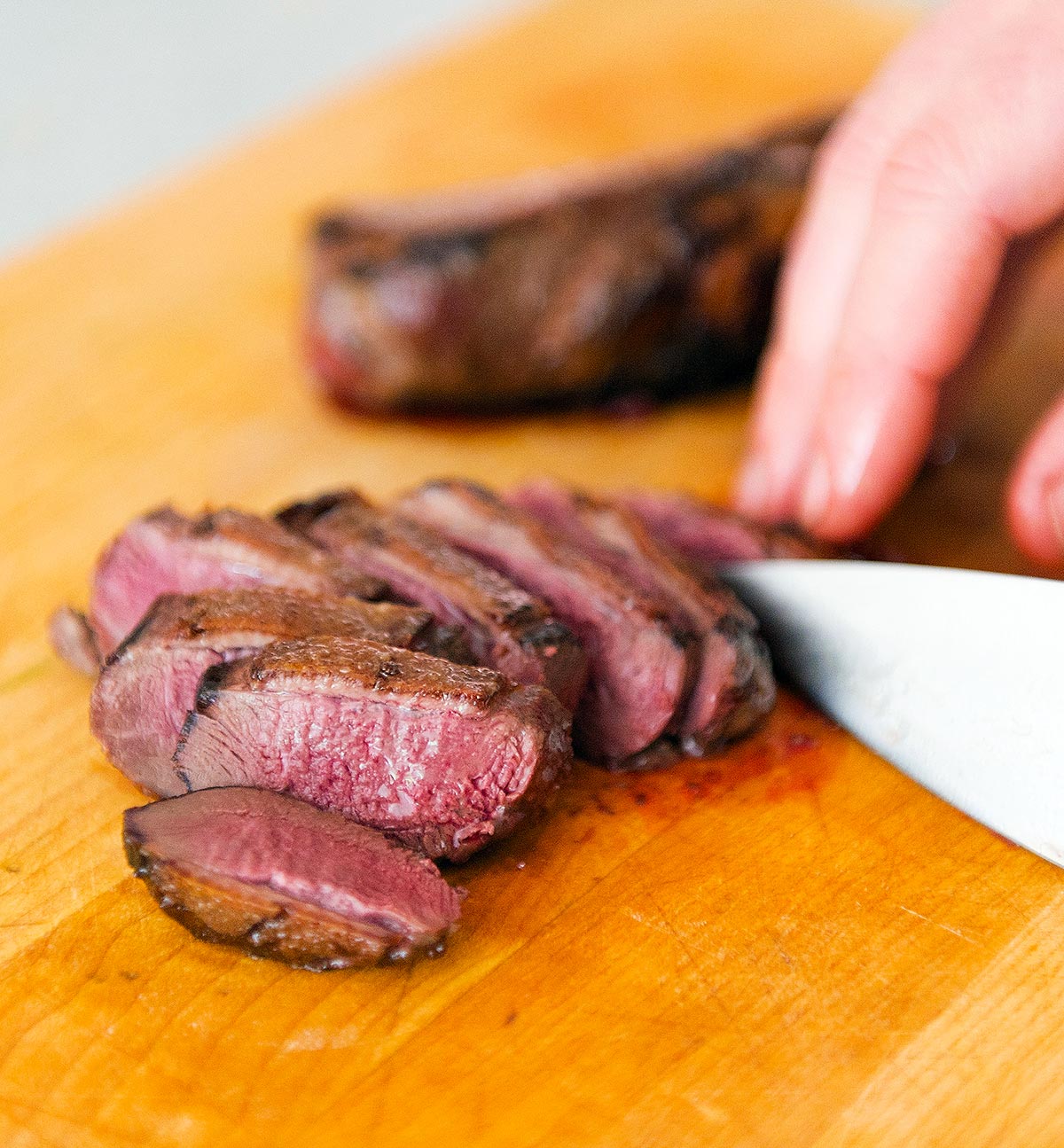
Take the duck off the heat and let it rest on a cutting board, skin side up. This would be a good time to grind black pepper over it. Teal need only need a minute or two rest, while big Canada geese might need 10 minutes. Everything else benefits from about a 5 minute rest. A duck breast is just like a steak: If you don't rest it, the juices will run all over your cutting board -- and not down your chin, where they should be. You can slice the breast from either end, either side up. You can get thinner slices by starting at the meat end, but you lose a little of the crispiness of the skin. If you are serving a whole breast, always serve it skin side up, with its sauce underneath.
Nutitrion
Serving Size: 1 serving
Calories: 287 kcal
Protein: 45 g
Fat: 11 g
Saturated Fat: 3 g
Cholesterol: 174 mg
Sodium: 129 mg
Reviews
Don on 2026-03-07 (5 stars): Excellent recipe it was sooooo delicious!!
Tracey on 2025-11-30 (5 stars): I was forced to cook up one of my domestic ducks thanks to neighboring dogs. This was the first recipe I came across and the breasts were perfect! Thank you for the insight
Verlee on 2025-09-02 (5 stars): The best instructions i have ever found.
Ari on 2025-05-15 (5 stars): You made me rediscover duck. As a carnivore, I eat steak basically everyday. I always thought duck was too tough and meh, but dang I was wrong! I simply used my legendary cast iron and a thermometer and cooked it to perfection. The crust was so beautifully crunchy I almost cried.
Brenda Funderburk on 2024-12-28 (5 stars): My son shared your website with me. Best duck I ever had! Thank you!!!
AJ on 2024-12-26 (5 stars): Delicious! I had an exceptionally large and fatty domestic duck breast to deal with, and this recipe worked well. I did drain excess fat out of the pan several times, otherwise I would have been deep frying.
Betty on 2024-12-04 (5 stars): Fantastic!! I read it a few times, followed it to the dot, and the meat came out unbelievably tender, moist, and delicious.
Erin W on 2024-11-29 (5 stars): 30 years of cooking duck breast, and they’ve NEVER turned out this perfect! I especially appreciate the suggested cooking times for wild vs. domestic. (I seasoned with salt, pepper, and light dusting of garlic powder—better flavor than I’ve had in any restaurant). Thx!!!
Rachel on 2024-10-05 (5 stars): What a great technique! I do recommend watching the video first. Apparently, my heat was closer to ROFLMAO than jocular. I had to finish this in the oven to keep from burning the fond. That said, it was wonderful. I used the fond for the Maple Bourbon sauce, which my husband daughter really liked. Thank you for the technique. Looking at the easy roast duck legs and this recipe, I am wondering how this would work out low and slow to mid rare, with a reverse sear at the end? Anyway, another great technique. Thank you
John Albritton on 2024-08-21 (5 stars): Thank you so much for the tip on how to cook duck breast. really do know how to instruct in detail and from a normal point of view rather than some high falootin' somebody that tries to be all that and then some and makes it more technical and difficult than it has to be. Like you have to have a degree to do something like this.
Billy on 2024-08-04 (5 stars): here for the same! the force is strong with this one
Katie on 2024-06-08 (5 stars): We've been following this recipe for years and you just can't go wrong - delicious duck breast every time.