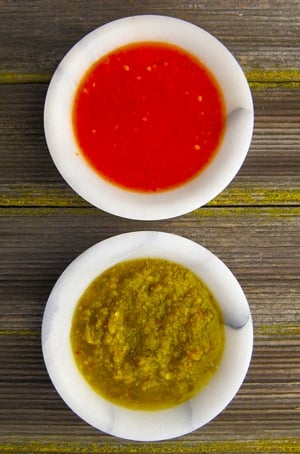
There are lots of variables going on with this seemingly simple sauce, so don't freak out if it doesn't taste exactly like Tabasco. It'll still be great. Your chiles will affect the flavor, as will where they were grown. So will your salt -- don't use iodized salt, it will muddy the flavor -- and your vinegar. Tabasco's private stock is made with white wine vinegar, and it is noticeably better tasting than the stuff you buy in the store. Use a good vinegar. And you really need the toasted oak cubes to get the full Tabasco effect. They store their mash in oak barrels, and unless you are making that much sauce, the oak cubes are the way to go. You can buy them at any winemaking shop or online. Try to let the mash ferment as long as you can. Every month you let it go makes it better. Finally, this recipe can be scaled up or down. Just remember, the key ratio is 2 percent salt by weight of the chopped-up chiles.
Recipe by Hank Shaw on August 21, 2014
Prep time: PT30M
Total time: PT30M
Rating
4.97 stars (28 reviews)
Keywords
chiles, fermented foods, peppers, pickled foods
Ingredients
3 1/3 pounds chile peppers, (about 1.5 kilos)
1 ounce kosher salt, (about 37 grams)
2 cups water
3 ounces oak cubes
4 cups white wine vinegar
1 teaspoon xanthan gum ((optional))
Categories
Condiment
Cuisine
American
Steps
Roughly chop the chiles and compost the stems. Blitz the chiles in a food processor or blender with the salt and water until you get a rough paste or slurry, depending on how much moisture there is in the peppers themselves. I keep the seeds in the chiles, but if you want a milder sauce, remove them.
Put the mash into quart mason jars and cap them loosely. "Burp" the caps at least once a day to let out escaping gases and let air in. The chiles will ferment like this for at least a week, and sometimes up to 3 weeks. When the chiles settle down, add the oak cubes, distributing them evenly throughout the jars. Tighten the lids and store the jars in a cool, dark place. I kept mine in my salami fridge, which is 55°F. A basement is fine, as would a fridge. Tabasco keeps their mash barrels at ambient temperatures, which in Louisiana can top 100°F. I am working on a batch fermented this way now, and I see no reason it won't work. Don't let the mash freeze, however.
Keep the mash like this no less than 3 months, and up to 2 years. When you are ready to finish the sauce, mix the mash with the vinegar.
You now have two choices: You can do what Tabasco does and return the mix to the jars, shake them every day for a month and then strain out the pulp and seeds. Or, do what I do and keep all that pulp, which will give the sauce body and thickness. If you choose my method, you will need to really blend the sauce and stabilize it -- otherwise the sauce will eventually separate and will need to be shaken up before each use. To do so, dissolve the xanthan gum in 2 tablespoons of water and add it to the blender. Blend for a solid minute. Let the sauce rest for 1 hour before bottling so any trapped air in sauce (from the blending process) can escape. Bottle and store. The sauce will keep for a year or more.
Reviews
TJ Nies on 2026-03-06 (5 stars): I have made a version of this recipe before and it is great! This prior year, I followed the recipe, but forgot about the mash. For about 6 months...
Is it still viable? There is a layer of a mold-ish substance on top, and the mixture is separated; do I just remove the body substance and continue?
Chris on 2025-03-04 (5 stars): Hey Hank - This is my second time making the sauce, so about to start another 2 year project. Wondering how you might modify this if you were actually putting the mash into barrels vs. using the oak cubes? I used oak cubes the first time, but I've found some 3-5 liter oak barrels that would work as well. The manufacturer says that sauce will age quicker because of more contact with oak. I guess I could test periodically, any thoughts?
Rob on 2023-10-02 (5 stars): Nice recipe - I grow Tabascos and make a sauce but use 6% salt - and put an additional salt cap on top of the mash in the container (I use wine oak barrels ) I scrape it off at the end of the aging. For some reason they told me (I used to be a supplier to them), that they used 6% salt and it works for me. Perhaps the 2.5% was salt content after vinegar was added? Anyways, love all of your postings.
Jack on 2022-01-15 (5 stars): Thank you sir!
Made some from your recipe before and it was great.
A batch of juicy big green Jalapeño chunks just went in a 3 litre bottle.
The 2.5% ratio of salt seems the magic number with many ferments (‘cept cucumbers that start with 2.5 but add more salt as the luquid in the cukes dilute the brine. )
Now to wait for couple days …
Tom on 2021-10-19 (5 stars): Excellent!! I grow a variety of chilies in the garden. I have waited 2 FULL years for the first batch and it was worth the wait!! Question: will this sauce keep without refrigeration or do I need to can it in a water bath? If the later, then how many minutes??? Am thinking 15-20 but am not sure. Lastly, will I have to check this website for a reply or will you reply directly to me and subsequently post to the site?
Michael Seltenright on 2021-09-02 (5 stars): I know I'm late to the party, but as someone that lives 15 minutes from Avery Island I have a couple comments.
They don't seal the peppers to ferment, after mixing with to 2.5% salt the mash goes into an open barrel the "seal" is a thick salt cap poured on top.
The oak barrels when they arrive at the factory are disassembled and cleaned, which includes removing any char on the inside. The peppers are fermented in clean oak barrels.
I personally like the flavor that the charred oak gives, I ferment in glass and and use charred live oak wood.
Al Pemberton on 2020-08-01 (5 stars): Hank,
I have gathered my gear, gathered my ingredients, read enough to be thoroughly confused, and am ready to start! Do I wash my home grown peppers? Or do I leave them "dirty"?