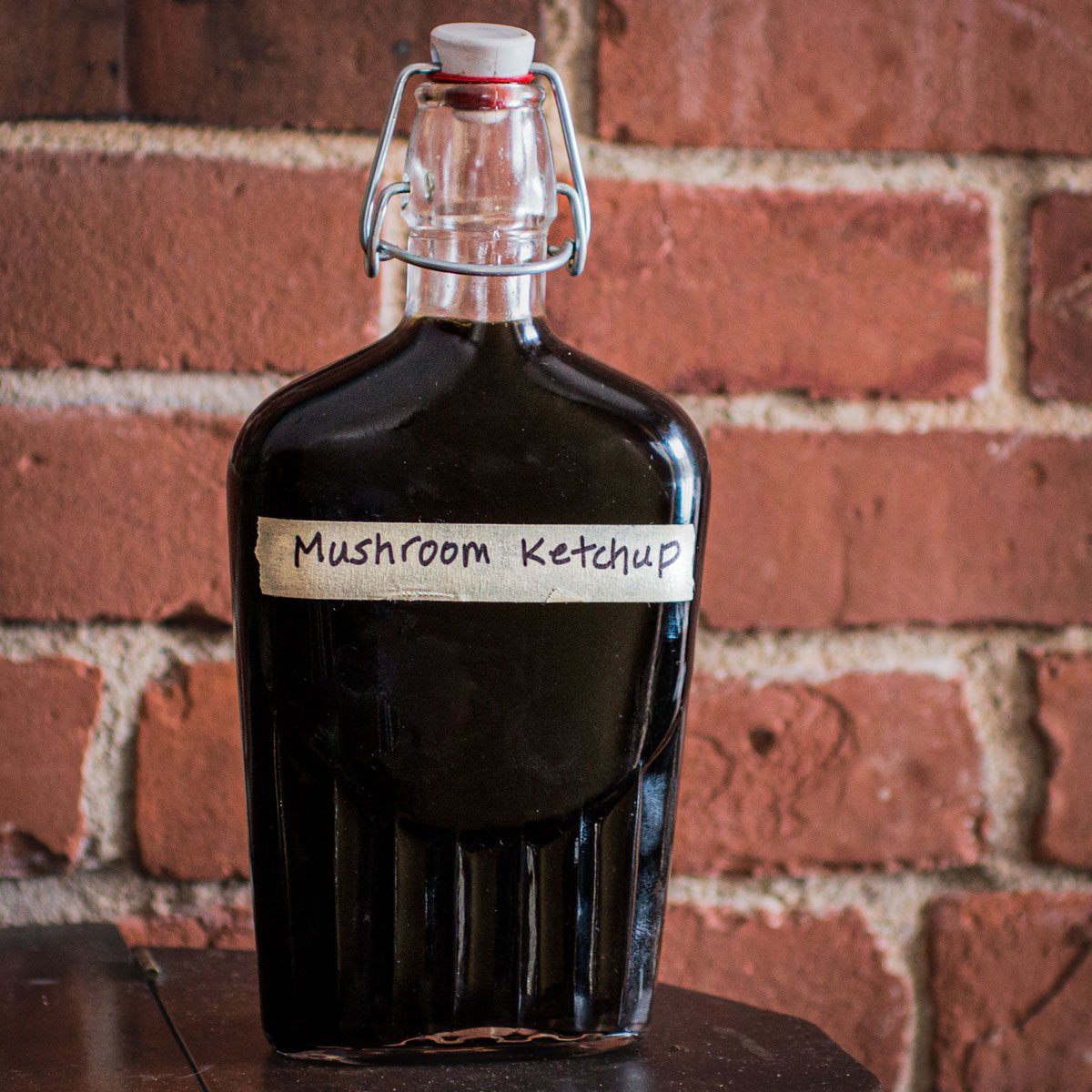
A classic condiment made from mushrooms. Makes about 4 cups.
Prep time: PT30M
Cook time: PT60M
Rating
4.95 stars (18 reviews)
Keywords
Black Trumpet Mushrooms, Condiments, Mushroom Ketchup
Ingredients
3-5 lbs wild or cultivated mushrooms, depending on availability (trim, woody ends, etc. )
85 grams roughly 6 tablespoons kosher salt
1 tablespoon ground black pepper
Up to 2 qts water (amounts of natural water in mushrooms will vary)
2 Tablespoons minced garlic
2 fresh bay leaves
1 Tablespoons allspice berries (toasted)
2 Tablespoons chopped fresh ginger
1 teaspoon dried thyme
10 whole cloves (toasted)
2 Tbsp worchesterchire, or to taste (optional, for color)
1 cups apple cider vinegar (or white wine, etc, use your favorite)
Categories
Snack
Cuisine
American
British
Steps
Crush or chop the allspice and cloves. Pulse the mushrooms in a food processor, being very careful to coarsely pulse them in small batches, as over-processing will give a cloudy sauce.
Combine the ground mushrooms with the salt and remaining ingredients except the water in a stock pot.
Assess the amount of liquid, adding some of the water to moisten until the mixture is wet and slushy (dryer mushroom like polypores may take up to 1 qt of water, where boletes and cultivated mushrooms might take half that) Transfer the pot to a burner and bring to a boil, then turn off the heat and leave overnight to cool and infuse. Transfer it to a smaller container that will fit in your refrigerator overnight.
The next day, warm the mushrooms and the liquid. Pour the mixture into a strainer lined with cheesecloth and allow to drain (you may need to work in batches. After the liquid has drained, squeeze the cheesecloth with a few handfuls of mushroom at a time to extract as much liquid as possible.
Reduce the liquid until roughly 4 cups remain (oruntil you like the flavor, it should taste a bit like light soy) then pour intoa labeled container, chill and refrigerate until needed.
The ketchup will keep for a long time.
Reviews
Christopher Karr on 2026-07-27 (5 stars): My usual spice mix is cardamom, pepper, garlic, and a decent wine vinegar, or even some reduced wine. Of course, spice preferences vary, and I don't find foods high in ginger to suit my usual cooking style. If you *do* play with the recipe, just be careful of ensuring the salt-to-weight ratio stays the same, and the pH stays nice and low (below 4.5pH is safe for about a month in the fridge).
So far as the recipe as a whole and the author's suggestions, I'd say this couldn't be much better. The ratio of mushroom to salt could use some dialing in for a more specific safe level (as opposed to a range of pounds of mushrooms to a specified amount of salt), but that seems more a factor of whether the person is using the mushroom solids in the final sauce, or just the liquid. This is because the liquids drained from the salted mushrooms will end with a higher salt concentration than the pressed solids, so adding the solid mass will require the sauce to have a higher initial salt ratio to maintain food safety.
I'm using shiitake and will likely blend half the solids back into the sauce, along with a bit of xanthan gum to stabilize it.
A note when using xanthan gum - It's best to stir it into a little bit of neutral oil prior to adding it into a food product. The powder has a bad habit of clumping when added directly to a water-containing liquid, similar to dry starch being added to boiling liquid. Just as you would mix corn starch with cold water before mixing into a hot liquid, you should do the same with xanthan gum and oil to make sure it disperses evenly in your liquid, hot or cold. My favourite use for xanthan gum, by the way, is stabilizing blended coffee drinks. It works a treat to slow the ice from forming a mass and lifting up out of the sugary liquid.
Christopher Karr on 2026-07-27 (5 stars): This is exactly correct. The use of salt in fermented or higher-risk foods is a measure to fight against pathogens. In this case, there is also pH modification used as an inhibitor of microbial growth. The two methods combine in a way which works synergistically, so less acidity and less salt is required to fully inhibit growth. The mathematics behind the correlated salinity:pH ratios is a bit complex for the layman, but one can think of it similarly to the temperature:time scale for pasteurization in foods. 145 Fahrenheit internal temperature for three minutes is adequate to pasteurize pork and poultry (If you do this, go for 10 minutes to be safe; there are tables online for temperature time pasteurization functions). But if you increase the temperature to 155F, the same level of pasteurization happens in 17 seconds. As a disclaimer, again, your temperature measurement may not be representative of the whole mass of food, so it's better to be safe and hold the temperature much longer. Anyway, that's a long way of saying, "There's a delta of effective salt and acid which is capable of entirely preventing growth of pathogens, similar to the delta of temperature and time to destroy them." It's worth noting that killing botulinum spores requires temperatures above 220F, which is practically unattainable in food at atmospheric pressure due to evaporation of water content.
Botulism is the greatest foodborne illness risk, here, due to the high protein content in the mushrooms, as well as their growth in proximity to soil, which is largely a contamination vector for botulinum bacteria. This is why preserving garlic is also either very precise, or very dangerous.
If you don't understand the exact fermentation and microorganisms you're working with, don't mess with the recipe. Beyond that, don't inherently trust the recipes. Always make sure a long-term storage product has a pH below 4.5 or is highly salted, and is written by a trustworthy person. Mushrooms are, to bacteria, basically meat. You wouldn't try to preserve meat without reasonable safeguards.
Tony Whitmore on 2025-06-20 (5 stars): Any suggestions on how to utilize the leftover mushroom mash after squeezing out liquid?
Dayna Litowski on 2024-12-14 (5 stars): Thanks for your reply. I ended up going out for a hike and found me a nice batch of mushrooms.
Made with chantrelles, winter chantrelles and hedgehogs. It turned out great! I dehydrated the leftovers after squeezing the sauce out of the cheese cloth, ground it uo, and am using it as a seasoning salt. So deeelish!!
I look forward to the dried mushroom recipe, as this year was amazing for mushrooms and we have dehydrated a lot.
Thanks