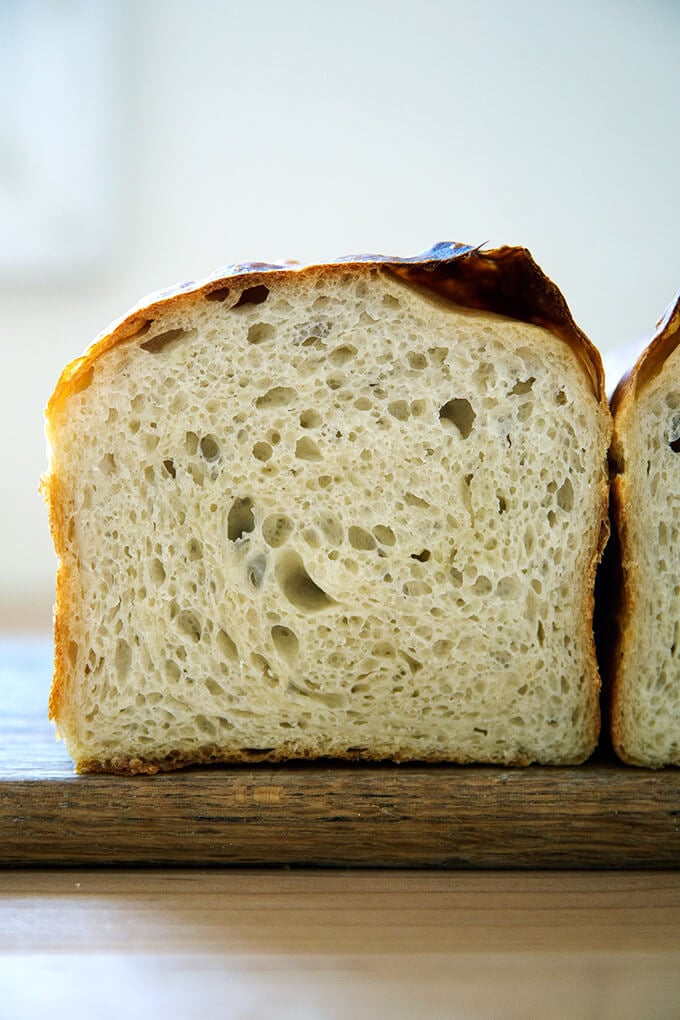
This easy sourdough sandwich bread requires no complicated shaping, no scoring, and no preheated heavy Dutch oven. Grab your mixing bowl, pull out a spatula, and butter your loaf pan. This one is simple and delicious!
Notes:
Pan: You'll need either a 10 x 5-inch loaf pan or a 9x5-inch loaf pan.
Plan ahead: This dough rises first for 6 to 18 hours (or less if it is super hot out or if you live in a humid area) or until the dough doubles in volume; then again for about 4 to 6 hours or until the dough crowns the rim of the baking vessel.
Troubleshooting: If you have issues with your dough being too sticky, please read this post: Why is my sourdough so sticky? The 4 common mistakes.
If you're just getting started with sourdough, check out this post first. You'll find tips there on procuring a starter as well as how to feed it and maintain it. If you're up for making your starter from scratch, you can do so in just about 1 week.
Water: Chlorine in water can adversely affect sourdough. Leaving water at room temperature for 24 hours will allow most of the chlorine to escape. When I am in the habit of making sourdough bread, I fill a large pitcher with water and leave it out at room temperature. I use this for my sourdough breads and starter. Truth be told, I've used water straight from the tap and have not noticed a difference.
Water quantity: Also, depending on where you live and the time of year, you may need to cut the water back. If you live in a humid environment, for instance, I would suggest starting with 400 g or 420 g water. If you are not using bread flour, you also may need to cut the water back a bit. So much success with sourdough relies on getting the water quantity right.
Starter: I use a 100% hydration starter, meaning it is equal parts by weight flour and water. If you need guidance on how to maintain a starter, see this post.
Recipe by Alexandra Stafford on April 17, 2019
Prep time: PT24H
Cook time: PT45M
Total time: PT24H40M
Rating
4.9 stars ( reviews)
Keywords
bread flour, sourdough starter, salt, water
Ingredients
100 grams (about 1/2 cup) active starter, see notes above
10 grams (about 2.5 teaspoons) kosher salt
430 grams water (or less, see notes above), room temperature
512 grams (4 cups) bread flour, such as King Arthur Flour
a few tablespoons extra-virgin olive oil
room temperature butter, for greasing
Categories
Bread
Cuisine
American
Steps
Place the starter, salt, and water in a large bowl. Stir with a spatula to combine — it doesn’t have to be uniformly mixed. Add the flour. Mix again until the flour is completely incorporated. If you have a straight-sided vessel, transfer the dough to it — it really helps monitor the rise and allows you to see the true growth in volume of the dough.
30 minutes after you mix the dough, reach into the bowl and pull the dough up and into the center. Turn the bowl quarter turns and continue this pulling 8 to 10 times. See video for guidance. If time permits, repeat this “folding” step every 30 minutes for the first two hours. (Note: even if you perform just 1 fold, your dough will be in good shape.)
Drizzle with a splash of olive oil and rub to coat. Cover bowl with a tea towel, bowl cover, or a lidded vessel, and set aside to rise at room temperature (70ºF/21ºC) for 4 to 18 hours — if it is super hot out or if you live in a humid environment, it may only take 4-6 hours. When the dough has nearly doubled in volume (or UPDATE: increased in volume by 50%, which is when I now end the bulk fermentation), it is ready. (Note: Do not use an oven with the light on for the bulk fermentation — it will be too warm. It is best to rely on visual cues (increasing in volume by 50% or doubling if you’ve had success with doubling) as opposed to time to determine when the bulk fermentation is done. A straight-sided vessel makes monitoring the bulk fermentation especially easy.)
When the dough has nearly doubled, grease a 9×5-inch loaf pan or 10 x 5-inch loaf pan with butter (or nonstick spray).
Drizzle dough with a few tablespoons of olive oil. Rub your hands with a little bit of oil to coat. Use your hand to release the dough from the sides of the vessel, being careful not to completely deflate the dough. Video guidance here. Turn the dough out onto a work surface. Quickly, shape the dough into a rectangle — fold the dough envelope-style first; then use a bench scraper to shape the dough into a rough rectangle. Transfer dough, seam-side down to prepared loaf pan and gently stretch into an oblong shape. (At this point, you can transfer the pan to the fridge if it makes sense with your schedule: rub the dough with oil and cover with plastic wrap, or tuck the whole pan into a 2-gallon ziptop bag. Transfer to the fridge till the next day. Then proceed with the recipe.) Leave the pan alone for 5 to 6 hours, or until the dough reaches the rim of the pan — this may take less time when it is very warm out. Do be patient with this second rise: to get good height, the dough should be near the rim of the pan before you transfer it to the oven.
Heat oven to 425ºF. Transfer the pan to the oven and bake for about 20 minutes. Reduce heat to 375ºF. Bake for 20 to 25 minutes more or until golden all around. If you have an instant read thermometer, it should register 206-210ºF or so before removing. Remove the pan from the oven and turn the bread out onto a cooling rack. Cool for at least 30 minutes before slicing.
Reviews
Gale on 2026-04-18 (5 stars): I am now making this sourdough sandwich bread with half or all full fat milk instead of all water. I find it soft and it keeps really well. I suppose you could also use dry milk mixed with the flour....
Gail Watts on 2026-04-22 (5 stars): Hi! I have made this loaf twice. I love it!! Not getting as much of a rise during baking as I would like. Trying to adjust the amount of water I use since I’m in a humid environment. I’m down to 407 gms. I think I will reduce it to 400.
The bread is absolutely delicious!!
Susan on 2026-04-24 (5 stars): Today will be my third time making this. We love it. Sandwiches and toast are the go to uses. I like the fact that it has a nice crust that isn't too tough.
I am looking forward to trying some of your other recipes.
Jed Levy on 2026-04-28 (4 stars): I usually lean towards the artisan boule, but I wanted to try a sandwich loaf like this one. I will say the taste is delicious but it seems far too hydrated/heavy. I'm definitely going to cut down on the water, and or maybe some starter? I think it will be great once I get the hydration in order. Not to be harsh, just honest 😊
Jed Levy on 2026-04-29 (4 stars): I tried this for the first time yesterday, The taste is pretty good But it's pretty heavy and overly hydrated with that much water I think, I'm going to try it again With less water
Jed Levy on 2026-04-29 (5 stars): Woops I replied twice lol my bad
Emily on 2026-05-11 (5 stars): Hi there, this is my go-to recipe for sandwich loaf bread. You have also have taught me how to make an artesian loaf, and maintain a sourdough starter as well, that now I’ve been able to teach my 11 year-old how to make. Your recipes are our go-to for many foods. Thank you!
I’m wondering, can I cold ferment this dough in the fridge for 12-48 hours in hopes of the ferment adding value to the loaf?
Tammy Thomas on 2026-05-15 (5 stars): Hello. I was wondering if I could adapt this bread for rye and wheat bread?
Tammy on 2026-05-20 (5 stars): Thank you Alexandra. What if I just wanted to make a Rye bread?
Cassandra on 2026-05-18 (5 stars): This recipe was easy to follow as a first timer! The crust was thin but delicious, and the insides were gummy. I used a food scale to measure out 100g Starter / 430g Purified Water (room temp) / 516g King Arthur Organic Bread Flour. I mixed everything with a spatula, and only enough until there was no more clumps of dry flour along the bowl and on the outside of the dough. Bulk fermentation on the counter for 4 hours, in the fridge for 18 hrs, proofed on the counter for 3 hours. I don't live in a humid area and it was around 77F throughout the day. For baking, I set the oven to 425F, and noticed the temp went up to 450F for about 5-10 mins of the 20 mins. Then I lowered the oven to 375F, left it for 22 mins. At the time I took out the bread, the oven was reading around 420F. The insides of the bread read 207F, and I let it rest for 1.5 hrs before I cut into it. I want to try this recipe again in a couple of days but I'm not sure where I need to make adjustments (except, maybe the oven temp). Thanks!
Cindy Luoma on 2026-05-20 (5 stars): How do you achieve that flat top? My loaf domed very high in the center, leaving two short edges which are not great for sandwiches.
Stash on 2026-06-06 (5 stars): I've made this recipe for years and it is flawless. I do a cold fermentation once transferred to a loaf pan for 12 hours. Let it rise out on the counter before baking. I top the glass loaf pan with another glass loaf pan when baking. Finish the last 10min uncovered and get an incredible golden crust.
This bread is fantastic and an absolute treat lightly toasted with a little PB&J. The entire loaf is gone once it's ready to slice (family of 4).